
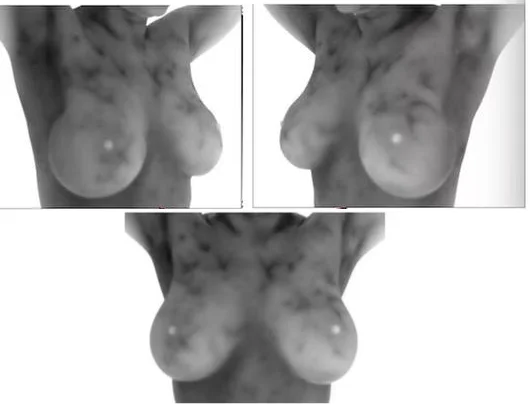
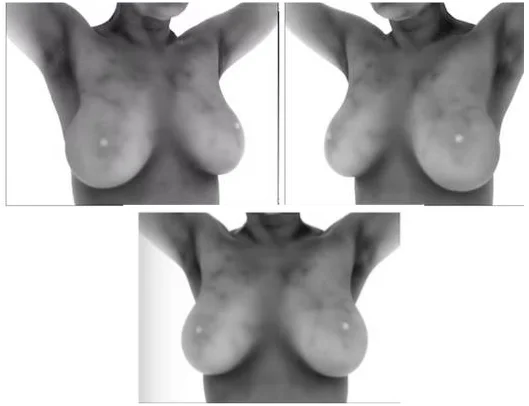
Your images are interpreted independently by a board-certified thermologist. You receive a written report with colour heat-pattern images, inverse grayscale vascular images, and the doctor's findings.
$300.00 · 30 min · report within 7 business days
Who Breast Thermography Is For
- Women who want to establish a personal baseline and track changes over time
- Women with dense breast tissue, which can make some other imaging harder to interpret
- Women with breast implants
- Women who want a screening option involving no radiation, safe to repeat as often as they wish
- Women monitoring a specific area of concern alongside their physician’s care
- Women who find compression-based imaging painful or difficult
- Anyone taking a preventative, whole-picture approach to their health
There is no age limit in either direction, and no body type the scan is unsuitable for.
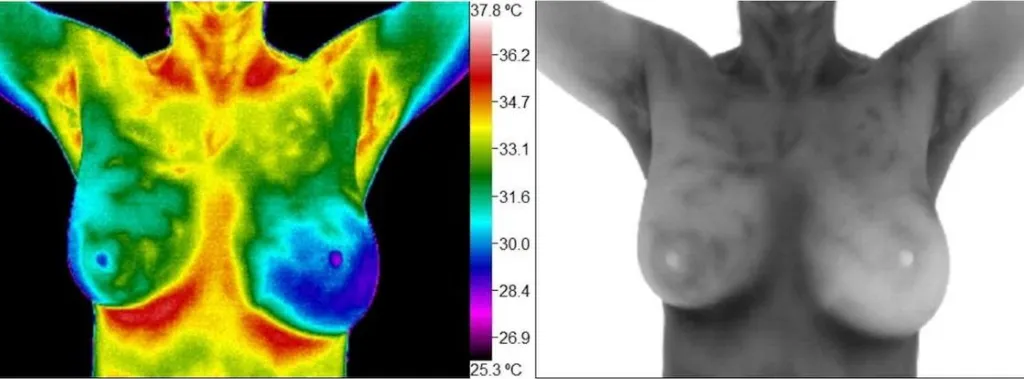
Thermography review prompted further testing, MRI confirmed right breast implant rupture
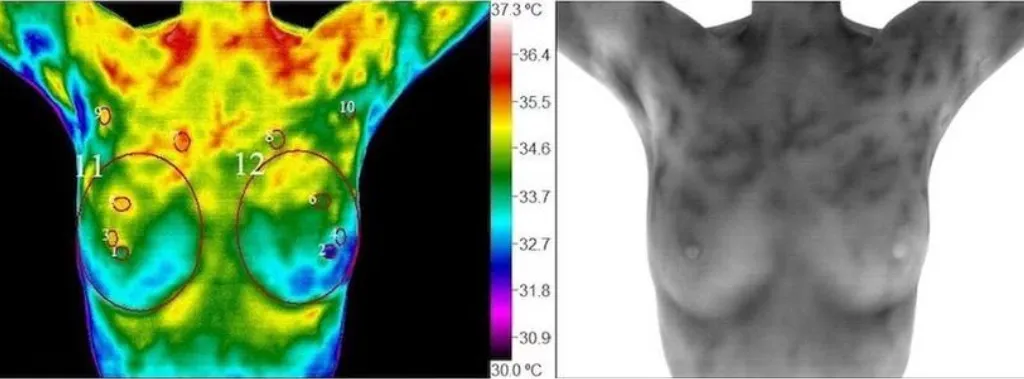
Thermal imaging showed heat patterns and biopsy confirmed right-breast IDC
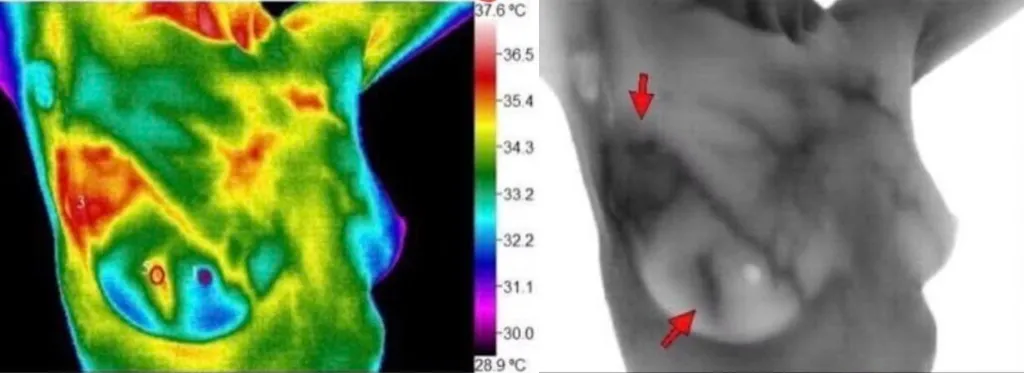
Invasive ductal carcinoma
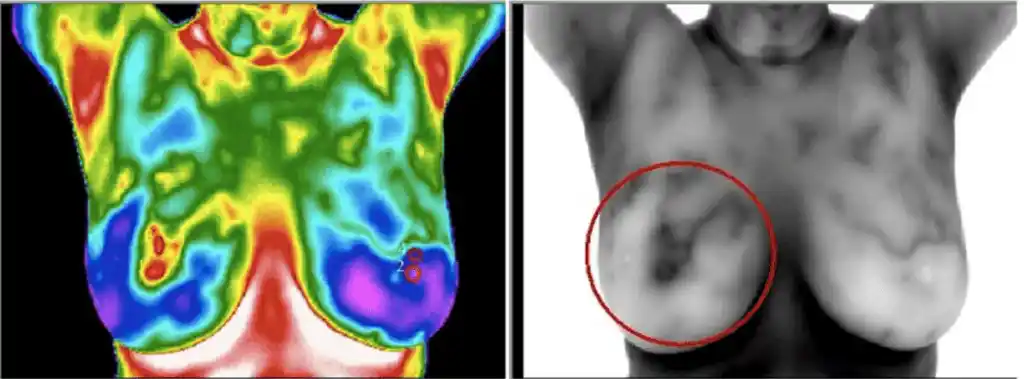
Breast cancer
What You Will Receive from Breast Health Thermography
Detailed report of key areas. Your report provides an in-depth analysis of your breasts, chest region and underarm lymph nodes. These areas matter for breast health because changes in temperature or blood flow can signal something worth a closer look. The imaging captures subtle physiological detail across all three.
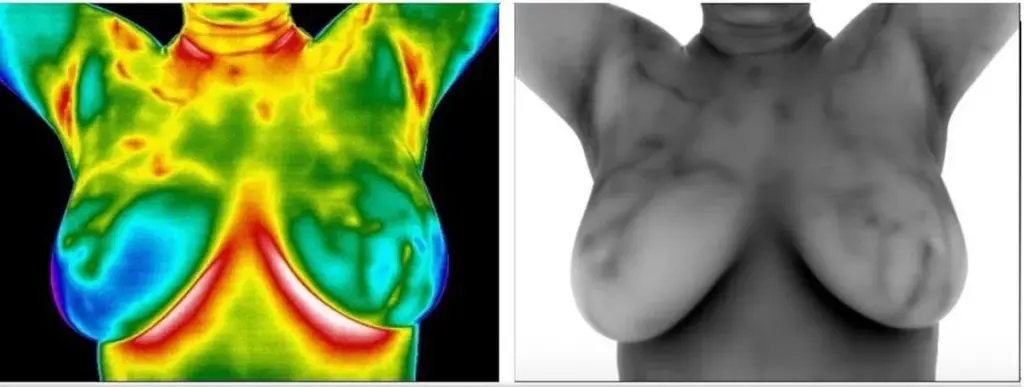
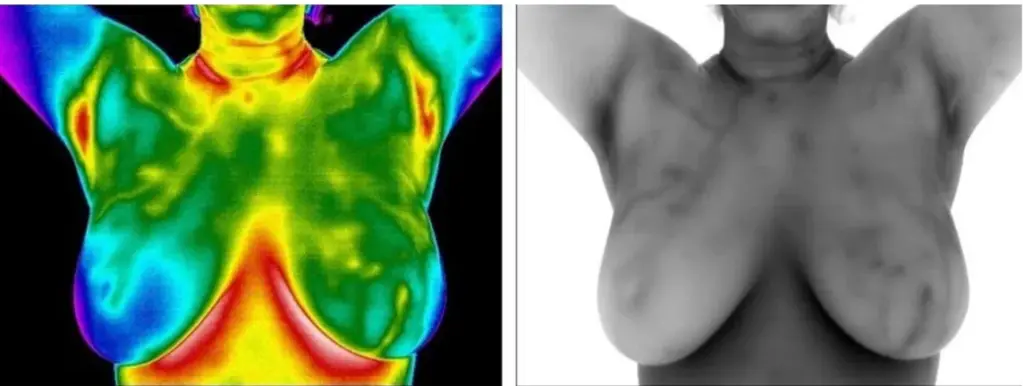
Rainbow images (heat patterns). A vibrant colour scale represents temperature variation — warmer areas appear as reds and oranges, cooler areas as blues and greens. These heat maps highlight increased blood flow or inflammation.
Inverse grayscale images (vascular patterns). These reverse black and white tones to emphasise blood vessel activity, giving insight into circulation. Together with the rainbow images they build a multi-dimensional picture.
Independent expert interpretation. Your images are not read by the technician who takes them. A board-certified thermologist reviews every study and explains what the heat and vascular patterns indicate — whether findings are unremarkable or suggest a need for further investigation, you will have what you need to discuss next steps with your physician.
Or one other region instead. The standard scan covers breasts, chest and underarm lymph nodes. If you would rather image a different single region of the body, the same scan and the same price apply — just tell us when you book.
Who Interprets Your Images
Robert L. Kane, DC, DABCT, FIACT has worked in thermal imaging since 1992. He holds Diplomate certification in Clinical Thermography from both the American Board of Clinical Thermography and the International Academy of Clinical Thermology, which named him a Fellow for his contributions to the field. He studied breast applications under Dr. William Hobbins, one of the field’s foremost authorities. He has served on the boards of both IACT and ABCT, trains thermography technicians, and has lectured on breast thermology at the Cleveland Clinic, Cedars-Sinai and the American Academy of Thermology. He runs an interpretation practice serving clients across the United States, Canada, Israel and the Philippines.
What to Expect During the Procedure
A non-invasive experience. An infrared camera captures images of your breasts, chest and underarm areas. There is no physical contact, no compression and no radiation.
The imaging process. You will stand in front of the camera in a private, temperature-controlled room. The imaging itself takes 5–10 minutes. Before it begins we will ask you to wait around 10–15 minutes so your skin temperature can stabilise in the controlled environment — this step is what makes the underlying patterns readable.
Comfort and ease. Thermography is painless and requires very little of you. Our technician will guide you through positioning.
Quick turnaround. Once imaging is complete your session is finished. Your report is typically ready within 7 business days.
The whole appointment takes about 30 minutes.
How to Prepare for Your Breast Health Thermography Appointment
These steps matter more than they might seem. Skin temperature is what the camera reads, so anything that heats, cools or restricts circulation in the hours beforehand can obscure the patterns we are trying to see.
Avoid activities that affect temperature or circulation
- For at least 24 hours prior, avoid sun exposure or sunburn to the area being imaged
- Do not undergo massage, chiropractic care, acupuncture, physical therapy, ultrasound, dry needling, laser therapy or similar treatments on or near the area being imaged
- Avoid ice packs, heating pads, saunas, TENS units or any electrical muscle stimulation within 24 hours prior
- No strenuous exercise for at least 4 hours before your scan
- No smoking, alcohol or caffeine for at least 4 hours prior
Dress comfortably
Wear loose clothing that is easy to remove or adjust. Avoid tight-fitting garments that restrict circulation or leave marks on the skin.
- Do not wear external breast prostheses for at least 12 hours prior
Hair
Please bring a hair tie or band. Hair must be worn up and away from the face, not covering the forehead, neck or shoulders during imaging.
Keep skin clean and product-free
- No lotions, oils, creams, powders or makeup on the area being imaged
- No deodorant or antiperspirant for upper body or breast imaging
- Do not shave the area being imaged for at least 24 hours prior, as this can irritate the skin
Before your appointment
- Do not bathe or take a hot shower within 1 hour of your scan
- If medically appropriate, avoid pain medications or vasoactive drugs beforehand — check with your doctor if unsure
Specific to breast imaging
- Do not nurse within 1 hour of the exam; allow as much time as you can
- Be ready to tell us which breast was last used and which is favoured
Health considerations
If you have a recent sunburn or skin burn, we may need to reschedule. Please bring any prior imaging reports or medical documentation relating to areas of concern.
Common Questions
How often should I have a scan?
Thermography is most useful as a series rather than a one-off, because what carries meaning is change over time. Many clients establish a baseline and then rescan annually; some rescan at three months when tracking a specific area. Since there is no radiation, there is no limit on how often it can safely be repeated.
Is breast thermography the same as a mammogram?
No — they look at completely different things. A mammogram is an X-ray showing the structure of breast tissue. Thermography shows physiology: patterns of heat and blood flow near the skin surface. Neither one tells you what the other does.
How much does breast thermography cost?
$300 for a 30-minute appointment. That covers the imaging, independent interpretation by a board-certified thermologist, and your written report.
Can thermography detect breast cancer?
Thermography does not diagnose disease of any kind. It records thermal and vascular patterns, which is physiological information rather than structural. If a scan shows something that warrants a closer look, the right next step is diagnostic testing through your physician, and we will say so plainly in your report.
Can I have thermography instead of a mammogram?
We would not advise it, and the FDA specifically warns against using thermography as a substitute for mammography. Thermography is best understood as something you may choose to do alongside the screening your physician recommends, not in place of it.
Does it work with dense breast tissue or implants?
Yes. Thermography reads surface temperature rather than imaging through tissue, so density does not interfere with it the way it can with some other methods. This is one of the more common reasons women choose it.
Is there any radiation? Does it hurt?
No radiation, no compression, no contact of any kind — the camera never touches you. Most people describe it as the easiest imaging appointment they have had.
How long until I get my results?
Within 7 business days. Your report includes colour heat-pattern images, inverse grayscale vascular images, and the interpreting doctor’s written findings.
Where are you located?
5555 Glenridge Connector, Suite 200, in the Glenridge/Sandy Springs area of Atlanta, GA 30342.
Do I need a referral?
No. You can book directly.